




- Details
- Category: Articles
 Proven Practices for Optimal Results
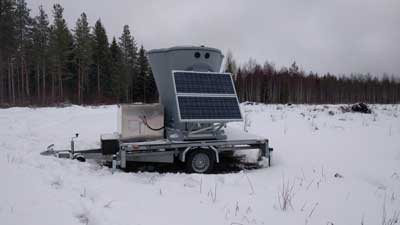
Onshore wind farm developers are increasingly looking to cold climate regions around the globe for various reasons, including the strength of the available resource and low population density. However, carrying out high-quality measurement campaigns in cold climates poses a number of unique challenges for developers.
By Juha Paldanius and Nihat Hunerli, Vaisala, Hamburg, Germany
Industry standards are typically created with more temperate sites in mind, close to infrastructure and population centres – not those located in remote areas prone to temperatures well below 0°C, with snow and ice posing further obstacles to accurate resource assessments. Equally, few measurement instruments are designed for these extreme climate conditions, and those that are typically do not have wind industry certifications. In addition, design requirements for met masts that can operate successfully in icy conditions come at a significant cost.
- Details
- Category: Articles
 What do Shark Fins, Winglets and Turbulators Have in Common?
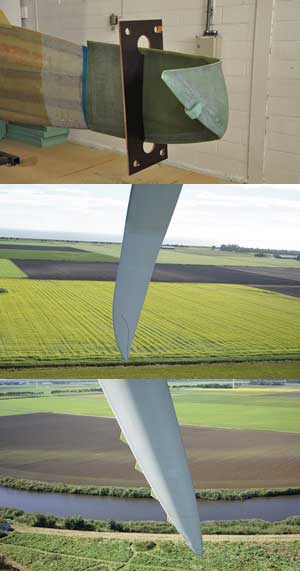
Ambitions and developments in offshore wind energy have forced us to re-evaluate our approach and methods in wind turbine blade design once more. With the ultimate goal of reducing the levelised cost of energy (LCoE) through optimised tip design, the InnoTip research project ran as a collaboration between LM Wind Power’s aerodynamics team and ECN. During this project three new tip designs were delivered and two were tested by extending the blades on ECN’s 2.5MW test turbines with a temporary add-on tip extension – a unique process.
By Ozlem Ceyhan Yilmaz, ECN, The Netherlands and Jordy van Kalken, LM Wind Power, Denmark
Project Overview and Motivation
Because of the differences between onshore and offshore operating conditions and constraints, the tip region of the blades for offshore turbines should be designed differently to obtain more power. In this research project, three different tip configurations were investigated. These were then designed and manufactured to be tested on LM 38.8-metre blades on the 2.5MW test turbines at ECN’s wind turbine test site (EWTW). It was quite a challenge to equip operating wind turbines with blade tip extensions for a limited period of time. However, the experiments were successfully completed and valuable data was collected. With the implementation of new tips, the measurement data showed an average of 6% power increase below rated speed, which was higher than the expectations. The results of this project prove that there is significant power enhancement potential when the tips of offshore wind turbine blades are designed differently.
- Details
- Category: Articles
 Enhancing Reliability and Reducing LCOE of Drive-Trains
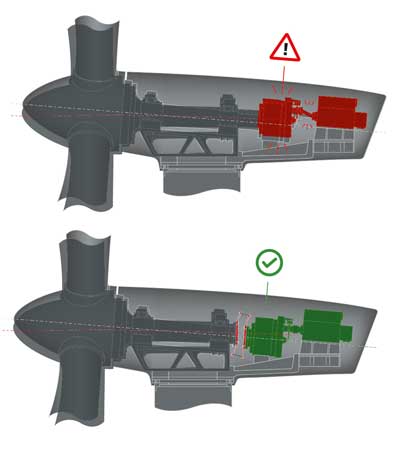
Advances in design, materials and drive-train testing have resulted in substantial improvements of wind turbine reliability, particularly in the 2–4MW class [1]. But with continuous growth in size of turbines, the risk of gearbox damage appears to be back on the agenda. Further upscaling of conventional drive-train designs is limited and alternative architectures might be required. A flexible element at the low-speed shaft allows the gearbox to be mounted rigidly to the main frame and relieves the gearbox from unnecessary stress and fatigue. The author of this article was part of a team that recently presented the results of a load study of such a system [2]. The focus of the current article is on a commercial study with the objective to identify the potential of reducing operational cost (OPEX) and enhancing levelised cost of energy (LCOE), using the example of a 6MW offshore wind turbine.
By Alexander Kari, Geislinger GmbH, Austria
This article is about a low-speed shaft coupling made of advanced composites. This coupling explicitly reduces non-torque loads, enhancing the dynamic system behaviour, and indicates the potential to reduce OPEX. Its weight-saving design is fatigue-resistant and maintenance-free and facilitates highly integrated next-generation drive-train architectures.
- Details
- Category: Articles
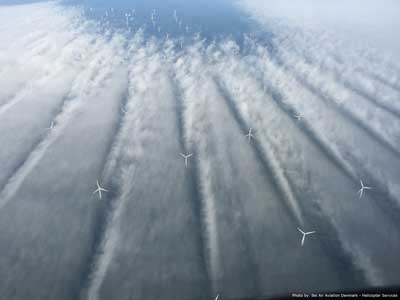 Fog Shows Amazing Details over North Sea Wind Farm
On 25 January 2016 at 12:45 UTC several photographs of the offshore wind farm Horns Rev 2 were taken by helicopter pilot Gitte Lundorff with an iPhone. A very shallow layer of fog covered the sea. The photos of the fog over the sea dramatically pictured the offshore wind farm wake. Researchers got together to investigate the atmospheric conditions at the time of the photos by analysing local meteorological observations and wind turbine information, satellite remote sensing and nearby radiosonde data. Two wake models and one mesoscale model were used to model the case and explain what was seen.
By Charlotte Bay Hasager, Ioanna Karagali, Patrick Volker and Søren Juhl Andersen Technical University of Denmark, Denmark and Nicolai Gayle Nygaard, DONG Energy, Denmark
What the Photos Showed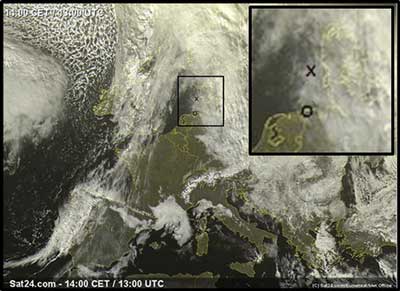 The fog in the photos is cold-water advection fog that originates from warm humid air flowing from the southwest over cold sea. In the wake of the operating wind turbines the fog is lifted up by swirling motion. The fog extends downwind from each wind turbine. Interestingly the wakes are relatively long and narrow. Meteorological observations and satellite data show the atmosphere to be stably stratified and this corresponds well to modest wake expansion. Furthermore it is noticed that the fog disperses downwind of the wind farm. This process is explained by additional mixture of warmer, drier air aloft.
- Details
- Category: Articles
Virtual Wind Farm Simulation
 The WakeBlaster project team was formed in January 2017 and is an interdisciplinary team of six dedicated scientists, software engineers, expert computer modellers and wind industry professionals. Together the team has over 55 years of experience in the wind industry. Its mission is to produce a cloud-based software component which delivers down-to-earth, cost-effective, scalable and dynamic yet accurate wind farm simulations.
By Dr Wolfgang Schlez, Director of ProPlanEn, UK
The development of fast and accurate wind farm simulation software is a crucial step to meet the needs of the industry. Developers and operators can simulate the response of wind farms before construction, optimise their strategies during operation and gain an advantage in electricity trading. We are living in interesting times, and with the new tools developed in the WakeBlaster project we can now realise adaptive wind farm control strategies.
- Details
- Category: Articles
 Use of Lidars to Quantify Flow and Wind Turbine Wakes
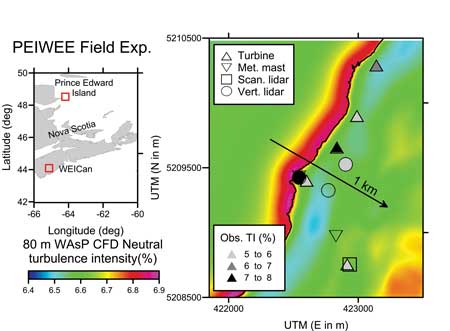
Wind turbine nameplate capacities (and physical dimensions) are increasing and turbines are being deployed in increasingly complex/harsh environments. Hence, shortcomings are becoming evident in our understanding of the flow parameters of relevance to wind resources and turbine loading in inhomogeneous settings. Furthermore, propagation and dissipation of wakes from turbines on ridges and/or on escarpments and/or when flow interacts with vegetation are incompletely understood. While model predictions of the mean and time-evolving components of flow may be imperfect in simple topography, model errors tend to be relatively small. However, systematic and non-trivial model biases can exist in complex terrain. Hence there is a need for full-scale experiments using remote sensing technologies (notably lidars) to quantify key flow characteristics and provide data that can be used in model development and evaluation. Here we describe some key research opportunities and challenges facing these experimental investigations and present results from our recent field campaigns.
By Rebecca J. Barthelmie and Sara C. Pryor, Cornell University, USA
Introduction of new measurement technologies (including lidar) requires careful performance assessment (accuracy, reliability and precision), robust uncertainty quantification and development of normative guidance (e.g. IEC 61400-12-1 protocols). It further requires development of expertise in the operation of lidar and analysis and processing of the resulting data. Some kinds of lidar are already in standard use, but use of remote sensing technologies to provide high-quality observations of relevant flow parameters in inhomogeneous terrain and/or complex forested terrain is not straightforward. Moving forward it is likely that integrated measurements from multiple different types of instruments including lidar will be needed to provide the quality and detail required to accurately predict power and loads on wind turbines in these more challenging environments.
- Details
- Category: Articles
 The Differences between Measured and Predicted Noise Levels from Wind Farms
When planning a new wind farm, it is essential to obtain a reliable estimate of the future noise impact. An underestimation of the noise impact can lead to complaints and subsequent possible loss of efficiency due to mitigation schemes like a temporary shutdown or the use of curtailment strategies. On the other hand, an overestimation of the noise impact leads to an underdevelopment of the wind park potential.
By Luc Schillemans, Tractebel, Belgium
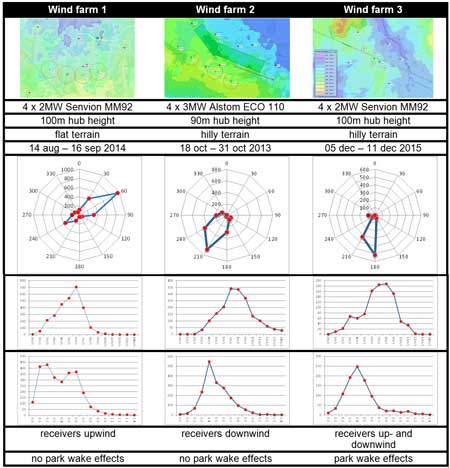
A joint research project between Engie, Laborelec and Tractebel was set up to investigate the reliability of noise simulations. This was done for three selected wind farms in Brittany, France. Detailed noise measurement campaigns were organised for several weeks. Numeric simulations were done with, on one hand, the widely used but basic ISO9613 method and, on the other hand, the much more advanced but rarely used Nord2000 method.