



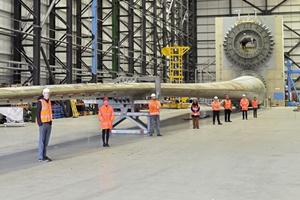
 A full-scale static test by Bladena, a RES company, at the Offshore Renewable Energy (ORE) Catapult in England has found that large wind turbine blades deform more under torsional loads than computer models predict. Engineers applied a controlled twisting force to an 88-metre blade at ORE Catapult’s National Renewable Energy Centre in Blyth, using more than 70 sensors to measure its response.
The test showed that twisting alone could distort the blade’s cross-sections and bend its outer shell panels, placing additional stress on internal webs and bonded joints. These effects are associated with known causes of blade damage.
When the measurements were compared with a computer simulation of the same blade under the same load, the model predicted where deformation would occur but generally represented the blade as 10% to 50% stiffer than it was in the test.
The findings indicate that existing models may underestimate blade deformation and the associated stresses that can contribute to damage over time. The measured data can be used to validate and improve the models, supporting more reliable assessments of blade durability, design and maintenance requirements.