





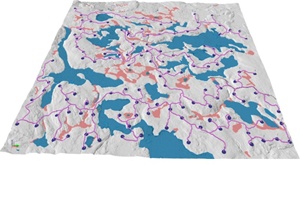
 Softree Technical Systems has introduced Path Explorer AI Road Networks in RoadEng Version 12, enabling engineers to generate access road networks connecting wind turbines while accounting for terrain, gradients and site constraints. RoadEng has been used to design forest and rural roads for more than 35 years. Softree is now applying the software to wind energy projects.
Path Explorer AI was introduced in RoadEng 11 to identify suitable alignments for individual roads between two points. Version 12 extends this capability to entire road networks. Engineers can connect existing roads, define waypoints and specify fixed road sections, allowing them to generate and assess a complete network during the planning stage before moving to detailed design.
Road networks can be generated in minutes for some projects, although larger projects take longer. In one example, the software designed a network connecting 130 turbines with more than 150 kilometres of road in approximately three hours.
The workflow includes importing project data, building a terrain model and generating a road network. Engineers can then refine alignments, assess earthworks using the Mass Haul module, optimise vertical road design and export construction-ready data.
RoadEng Version 12 also includes updates to its Terrain, Location and Alignment modules, including new grading tools, hydrology tools in the Location module and three-dimensional visualisation of road cuttings.
Path Explorer AI is available through Softree Optimal, an optimisation add-on for RoadEng.