



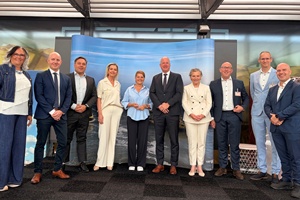
 Rijkswaterstaat has started the research and development phase of the Power2Tow project, an innovation partnership aimed at developing near zero-emission Emergency Response Towing Vessels (ERTVs) and associated charging infrastructure for offshore and onshore use. The programme marks the formal start of the development phase, with Director-General Martin Wijnen signing cooperation agreements with three selected consortia on 30 June. Under the approach, all three consortia will work in parallel during the research and development phase, receiving compensation to refine and test their proposed solutions.
The model allows multiple technological pathways to be explored, covering vessel design, offshore and onshore charging infrastructure, and operational deployment concepts. One consortium will later be selected for full delivery of the project, enabling a direct award for construction and operation without a further procurement process.
The selected consortia are Kustkracht, comprising Kotug International, IHC Defence and Bluewater Energy Services; Multraship Ocean Towage, Damen Shipbuilding and Stillstrom; and Smit Terminals Europe and Smit Salvage.
The Power2Tow project includes the development of three electric ERTVs designed to charge offshore using wind energy, supporting the protection of offshore wind farms from vessel collision risks. The programme also covers the development of charging infrastructure at sea and on land, alongside a 25-year service provision period.
The vessels will operate primarily on electric power where possible, with sustainable e-methanol intended for emergency towing operations. Power2Tow forms part of the Netherlands Fleet Renewal Programme for the Rijksrederij and is being delivered in cooperation with the Ministry of Infrastructure and Water Management, the Ministry of Economic Affairs and Climate Policy, the Netherlands Coastguard and the Maritime Manufacturing Industry Coordination Office.
Rijkswaterstaat, Power2Tow, Netherlands, ERTV, offshorewind