



- Details
- Category: Articles
Power Curve Verification Using Ground-Based and Nacelle-Mounted Remote Sensing Devices
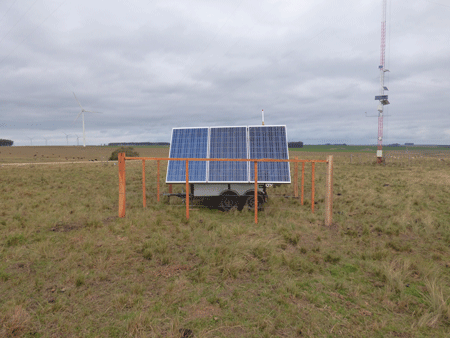 A power curve measurement using remote sensing technology was performed in Uruguay after previous measurements had been completed by an independent laboratory, and the results showed that the measured power curve was considerably below the advertised one. The classification procedure of the ground-based lidar and the power curve results according to the IEC 61400-12-1 Ed. 2 standard are presented in this work.
By Andres Guggeri and Vasilii Netesov, Ventus Energía, Uruguay
Introduction
- Details
- Category: Articles
 Using Interfering Sound Waves for Monopile Investigation
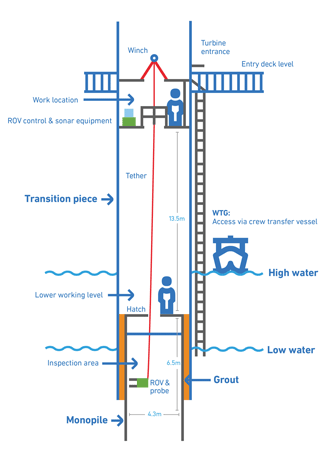
Offshore wind farm operators face a challenge when trying to establish the integrity of the monopile-transition piece interface which has been used in 80% of turbines constructed before 2012. A key focus is the layer of grout which bonds the two steel sections of the structure, the integrity of which could affect the turbine’s long-term stability. Uniper Technologies, working with a team from the British Geological Survey, has developed a system, the first of its kind, which uses interfering sound waves to investigate the monopile-transition piece underwater and highlight any areas of defective or missing grout. The system, which has been successfully trialled at sea, was a winner of the recent Subsea Inspection competition organised by the Carbon Trust’s Offshore Wind Accelerator. Importantly the technique can inspect the structure from a single surface and within the tight timescales required for offshore procedures. Inspection data is interpreted and shared in a transparent format.
By Dr Colin Brett, Head of Inspection, Uniper Technologies, UK
The majority of offshore wind turbines constructed before 2012 use a system in which grout – a high-strength, fast-curing cement – is pumped between the steel monopile and transition piece (see Figure 1). An estimated 35–40% of monopile turbines have potential grouted joint issues, and so an inspection technique that is accurate and meets operational requirements has major potential benefit for the offshore industry.
- Details
- Category: Articles
 Breaking the Logistic Barriers in XXL Blades Industry
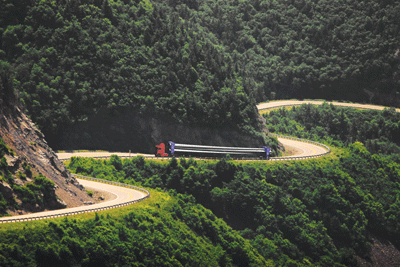
The growth of the wind market, together with the low availability of sites with optimal wind conditions, is creating a rapid increase in the size of turbines and therefore the diameter of some rotors that work at specific low power levels. This leads to the need for longer blades whose transport is, more and more frequently, a major logistical challenge that manufacturers must face. The modularisation of these blades is presented as a solution to reduce the costs of, or even make feasible, wind farms with more complicated logistics. The main OEMs are all working on modularisation developments that aim to lead to a reliable solution with an acceptable impact on the rest of the machine.
By Javier Iriarte, Senior Engineer at Nabrawind Technologies, Spain
Modular Blades in the Wind Industry
A trend towards an increasing size of blades in the wind industry is evident. The major wind turbine manufacturers are announcing rotors of more than 150 metres in diameter for new land-based wind turbines.
- Details
- Category: Articles
 Technology to Enhance Remote Wind Energy Staff Welfare
Wind energy providers know that retaining their most knowledgeable staff is critical to ensuring maximised operational efficiency. It’s also good business. Experienced team members perform duties more rapidly, and have more know-how to draw upon in challenging situations. But working conditions in the field can be harsh. Installations are typically remote and subject to sudden and dramatic weather changes. This article looks at what can be done to enhance the welfare of staff working in such conditions and to make sure they can be rescued when necessary.
By Gavan Murphy, Director of Marketing EMEA, Globalstar, Ireland
For both onshore and offshore wind energy field workers, risks include all the usual hazards associated with major construction and maritime projects, but these are compounded by the ever-present risk of fire. Meanwhile, access by emergency services in the event of an incident can be challenging.
- Details
- Category: Articles
 Overcoming the Problems of Size and High Wind Speeds
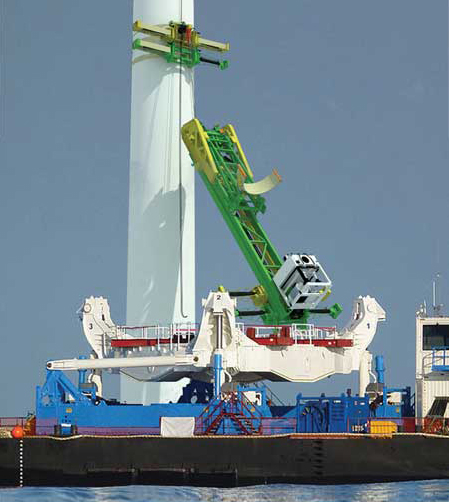
Wind farm sites have the annoying habit of being located in places with frequent high-speed winds! Also, the trend in the wind industry is to create bigger and taller wind turbine generators in order to produce more megawatt-hours. Unfortunately, construction and maintenance activities with the need for ever larger cranes to lift bigger loads to higher heights are not particularly compatible with high-speed winds.
By Emmanuel Garcia de la Pena, Managing Director, KoalaLifter, Spain
Because of the lack of availability of the huge cranes needed to reach the heights required and withstand high wind speeds, the wind industry is facing a significant roadblock to its development in many regions. And even where these cranes are available, their high rental and mobilisation costs make many wind farm business cases unfeasible.
- Details
- Category: Articles
 Condition Monitoring of Wind Turbines Using Non-Contact Acoustic Sensors
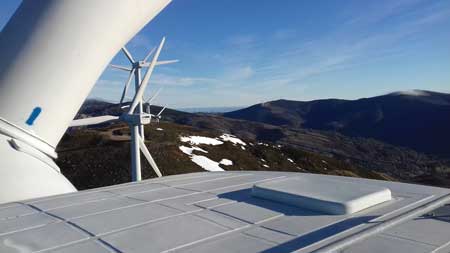
The reliability of drive-train components in wind turbines is still a problem. The failure of a wind turbine’s main components (i.e. gearbox, generator, etc.) usually lead to extended downtime that reduces the power generation capacity and increases the levelised cost of energy (LCOE). Vibration-based condition monitoring (CM) strategies have been widely used to reduce the downtime and schedule the maintenance programmes efficiently. However, there remain some drawbacks such as the excessive costs and intrusiveness due to contact of the accelerometers with the machinery. To solve these issues the CMDRIVE project seeks to develop a novel low cost CM solution for the drive-train based on non-contact acoustic sensors. This article describes the features of this new system including its advantages and the results of field trials in a real wind turbine.
By Juan Luis Ferrando, Senior Project Manager, Inesco Ingenieros, Spain
The Problem
Due to high competitiveness in the energy market, and because several technologies such as solar power are quickly reducing the LCOE, cost reduction is becoming crucial. For this reason, wind farm owners and manufacturers are seeking solutions to increase the reliability of their assets. Drive-train components such as generators and gearboxes are among the most critical components of wind turbines. The failure of these components incurs excessive costs, primarily due to the downtime associated with the failure. Traditionally vibration-based CM systems have been used for the diagnosis of the drive-train components of wind turbines. However, the cost of such systems is still high. This solution usually implies the installation of 8 to 12 accelerometers in the drive-train, incurring high costs and reducing the competitiveness of the wind power industry.
- Details
- Category: Articles
 Cable Stocking with Self-Extinguishing Plastic Coating
According to power reports, with its 50,018MW of generated wind energy Germany is Europe’s leader of installed wind power plants. By the end of 2016, a total of 28,217 wind power plants supplied 12.3% of the power produced in Germany. However, although there is an increasing number of new installations, the applied technology still has its weak points. For example, recurrent fires cause significant damage and even personal injury. Fires may arise as a result of short circuits and flying sparks caused by worn-out cable insulations inside the narrow generator houses.
By Hans Benkert, CEO, rupi-Cologne, Germany
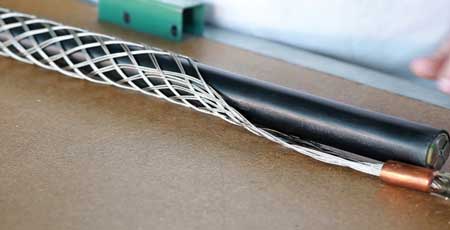
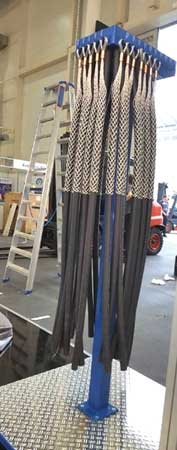 To reduce the risk of fire, in addition to securing the cables and avoiding wire breakage, rupi-Cologne has developed the rupi-Blue cable stocking, which consists of braids made of a V2 flame-retardant plastic coating. The relatively soft material avoids metal-on-metal friction, thus reducing fire risks and significantly increasing the service life of the plants.