




- Details
- Category: Articles
 The BLUE 25M Hammer
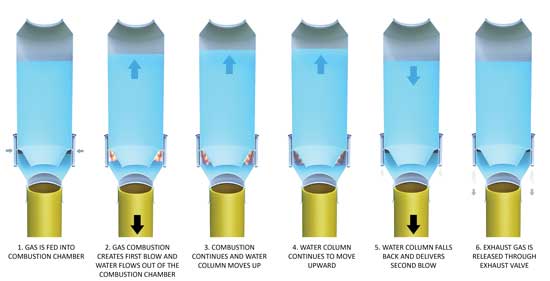
In recent years the offshore wind industry has gained an increased awareness of the detrimental effects of underwater noise caused by pile driving. This has resulted in the need for noise mitigation measures and legislation to reduce the negative effects of foundation installation. All across Europe this legislation is getting stricter. In Germany, where the legislation is strictest, up to 40 million euros are spent per wind farm to reduce the effects of underwater noise. Fistuca BV is currently building a hammer, the BLUE 25M, that can compete with the largest hydraulic hammers in the industry, which tackles the noise issue at the source.
By Jasper Winkes, Fistuca BV, The Netherlands
Fistuca started as a spin-off from the Eindhoven University of Technology. Development of BLUE Piling Technology started in 2011. Since 2015 Huisman Equipment, a renowned equipment supplier for the offshore industry, has invested in Fistuca. In 2016 the construction of the largest hammer in the world started.
- Details
- Category: Articles
Performance Evaluation Strategies Based on Raw Data
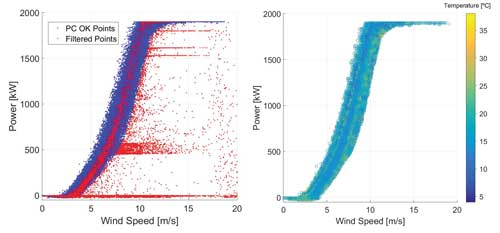 Identifying a change in the performance of a wind turbine generator (WTG) using the raw SCADA data may not be a simple task, particularly because the variability of the 10-minute values during normal operation is quite wide. This article presents four methods to evaluate the performance of WTGs over time using power, wind speed and ambient temperature SCADA measurements. We named these methods ‘Power Residuals’, ‘Health Value -PC2 Dev’, ‘Quantiles’ and ‘Power Curves Evolution’, and in each we calculate a key performance indicator (KPI). These KPIs can be useful to identify changes or trends in the operation of the turbines, assess an improvement in the performance of the WTG after maintenance is done and help in the detection and prevention of possible failures in components which are directly related to the performance of the turbines (e.g. anemometers). An algorithm to automatically identify the changes in the KPIs is also presented.
By Andres Guggeri, Martín Draper, Alvaro Díaz and Vasilii Netesov, Ventus, Uruguay
 Firstly we describe the selection and filtering of the SCADA data, then the following four sections present the KPIs, depicting how they are calculated and their characteristics. We then introduce the ‘Change Detector’ algorithm and the last section shows some results of the application of these indicators to one WTG.
- Details
- Category: Articles
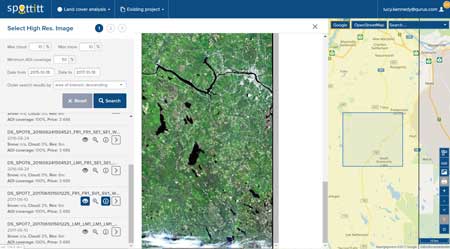 An Online Application to Remotely Select Wind Farm Sites with Suitable Geography
Spottitt is an online application that can seamlessly search and access up-to-date satellite imagery and data in order to perform industry-standard analyses that are currently executed manually. This article describes how Spottitt works and also outlines the advantages derived from the use of fully automated on-demand satellite image and data analyses, in terms of saving time and money, as well as minimising errors and human intervention.
By Marcello Deplano, CMO, Spottitt, UK
 Spottitt puts onshore wind farm developers in the unprecedented position of being able to automatically scout for the best onshore wind farm locations, anywhere in the world. So far, most automation R&D in this sector has been dedicated to the prediction and modelling of wind resource availability. Far less effort has been invested in helping developers to automate the assessment of geographical, environmental and logistical constraints. With increasing turbine efficiencies, understanding these aspects in a timely and error-free fashion can be just as critical as assessing wind when it comes to minimising the cost of energy.
- Details
- Category: Articles
 GIS Shows Us How Many Could Be Realised
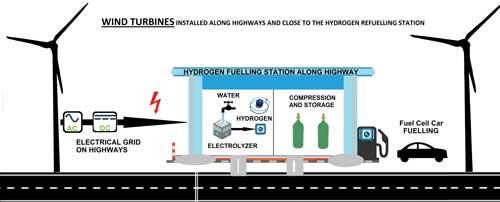
For a hydrogen economy, hydrogen refuelling stations will be needed to provide fuel for vehicles. This could easily be done by retrofitting existing fuel stations. Some of these are located away from urban centres or outside populated areas. On-site wind-powered water electrolysis is a potential solution. The advantage is cost allocation, due to integration of systems with current infrastructures and effective use of energy. In order to estimate the potential of this application, GIS could be used to give us an answer on which to base further system developments. Maps containing road networks, land, wind and station data could be layered and analysed. At TU Delft, Professor Ad van Wijk and PhD student Nikolaos Chrysochoidis-Antsos are working on developing these maps and alternative wind-powered hydrogen production and refuelling concepts.
By Nikolaos Chrysochoidis-Antsos, Technical University of Delft, The Netherlands
 Hydrogen Mobility in Germany
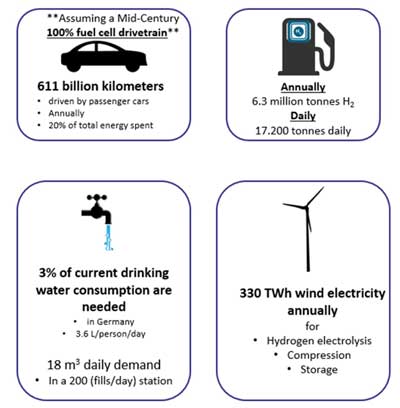
In Germany, passenger vehicles are driven a total of 611 billion kilometres each year. This would require 17,200 tonnes of hydrogen on a daily basis, which would need to be distributed accordingly. Some hydrogen will come as a by-product of industrial processes, or through water electrolysis, or through steam reforming. Green hydrogen comes from water electrolysis. If all hydrogen came from water electrolysis a total of 330TWh of electricity would be needed to cover this annually. Some of this electricity could come from wind energy supplied to the grid, and another smaller part from on-site wind-powered hydrogen production. The hydrogen refuelling stations could utilise this concept. Regarding the water consumption, only 3% of current drinking water consumption would be needed to produce all this hydrogen. For a fuel stations with 200 fills per day this means that 18m3 of drinking water would be needed to feed the electrolyser. These numbers provide a first impression on the feasibility of this economy.
- Details
- Category: Articles
Providing Quality Assurance Over the Lifetime
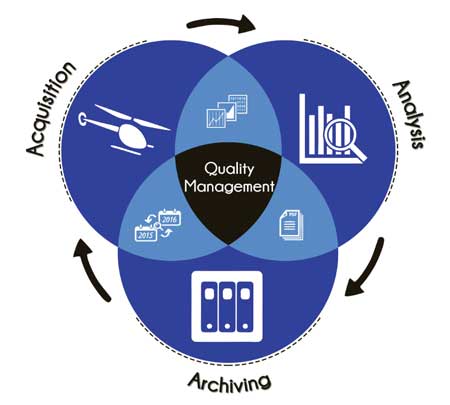 The standard inspection method for quality assurance of the exterior surfaces of wind turbines is to employ people trained as rope access or industrial climbers. But this is not the only way. This article, by Robert Hörmann of Aero Enterprise in Austria, outlines (using his company’s products) how drones can undertake visual inspection of turbines, and then supporting software and archiving can be used to analyse the data. As the author admits, drones and airborne access will never be a complete substitute for manned inspection, and there will always be the need for rope access workers, but he shows that there are many advantages to drone-based inspection together with software analysis and archiving.
By Robert Hörmann, CEO/CTO and Founder of Aero Enterprise, Austria
Aero Enterprise GmbH, a young company located in Linz, Austria, is active in the field of airborne quality assurance. The company was founded in 2013 and provides its service with a comprehensive system consisting of a helicopter-type flight-robot (drone) called SensorCopter, client-based analysis software, AERO-Lyse, and a database where all the gathered data is stored. Data mining and machine learning tools enable clients to use the data not only for statistics about the present state of the turbine but to predict upcoming demand for maintenance. Customers are operators of wind farms, service companies, insurance companies and OEMs, as well as technical experts in this field. The technology can be applied to all kinds of vertical objects and helps to reduce maintenance and long-term aftersales costs.
- Details
- Category: Articles
Towards a Significant CoE Reduction
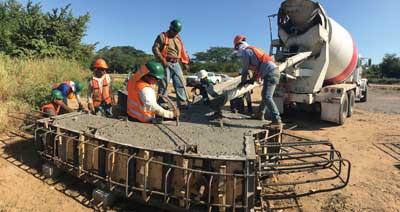 The auction system is leading to reductions in the price of energy worldwide. At present every competitor involved in the sector is focusing on maximising energy production while trying to minimise the investment needed for this purpose. One of the trends is the use of higher towers and more powerful turbines. This leads to an increase of foundation loads, and hence higher volumes of concrete on regular shallow slab foundations. Nowadays values around 400–450 cubic metres of concrete per wind turbine generator (WTG) foundation are common and therefore efforts are being made to reduce both this concrete volume and the amount of reinforcing steel in the WTG foundations. So far, most of the innovative solutions have not had a significant penetration into the market since although there were material savings there were also much higher execution costs as well as longer construction schedules.
By Ramón López Mendizabal, Esteyco Energía, Spain
Introduction to the Concept of Precast Braced Foundations
The precast braced foundation comes as a result of the extensive experience collected by Esteyco Energía and its professional team in the WTG foundation sector – with more than 6,000 WTG foundations designed and already built – together with the company’s pioneer experience as precast concrete tower designers – with around 1,000 WTG towers already built or under construction. This background led the company to come up with a 100% owned, patented and certified design and foundation solution.
- Details
- Category: Articles
The Use of Nano- and Micro-sized Particle-Based Lubricant Additives
Nano- and micro-sized particle-based lubricant additives are used in wind turbine applications, and also in engines, gears and bearings in different industry sectors such as cement, steel, mining, maritime and automotive around the world. Treated machinery, gearboxes and bearings can run better with reduced friction and temperature and greater reliability and durability due to reduced abrasion and wear. Rewitec is an independent, medium-sized business that develops such additives, and in this article its Managing Director Stefan Bill describes how the company’s products have undergone tribological tests and been shown to provide life extension upgrades.
By Stefan Bill, Rewitec, Germany