



- Details
- Category: Articles
 An Integrated Energy Storage System
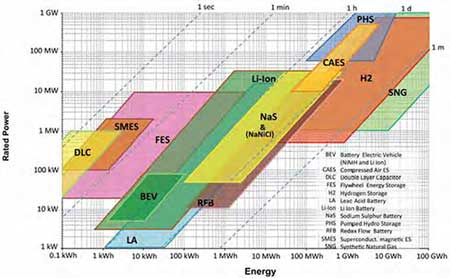
Wind speed is unpredictable and variable such that the power output from wind turbines often does not coincide with demands from the national grid. In the UK, constraint payments are made to wind farm owners when the turbines are shut down because of lack of demand for their power. Clearly the wind farm owner would wish to sell any energy generated whatever the demand and also be able to deliver higher power if necessary on demand. Here a novel wind–tidal integrated storage power generation system is described that addresses these issues.
By Mike Lewis, RGL Associates, UK
Matching Output to Demand
There is increasing interest in storage devices that can buffer energy during times when the wind is blowing and there is little demand and allow that energy to be released when demand is present. By contrast, tidal energy is predictable throughout the year but still has the disadvantage that differential heads across water turbines that give the highest power outputs may not be in phase with demand. Storage devices are essentially energy supply shifters.
- Details
- Category: Articles
 Using Pneumatic Power to Generate Wind Energy
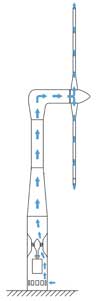
Over 60 years ago a 100kW test wind turbine was built with pneumatic power transmission in southern England (Figure 1), based on a design patented by M. Andreau. Test results from the turbine showed a lower energy extraction than was obtained by wind turbines with conventional mechanical power transmission, and therefore the pneumatic power transmission was abandoned, without attempting to improve it. Our team has re-investigated this type of transmission, and following a number of patented innovations we have been able to considerably improve on the previous results. We are now hoping to upscale our working models for field testing.
By Dr Endre Mucsy, Hungary
Below we discuss the differences between conventional and pneumatic turbine types and their resulting properties. Why was the potential of pneumatic power transmission underestimated and abandoned? What design changes did we make to improve the efficiency of the pneumatic turbine, and how have we tested them? Finally, how much energy is there in the wind and what proportion can be utilised?
- Details
- Category: Articles
 A Serialised and Standardised Product Platform for Wind Drives
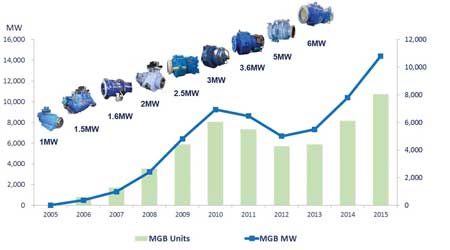
NGC StanGear is a serialised product platform based on an application database, standardisation, and a modularisation concept for wind gearboxes. The approach of NGC is based on its experience of over 50,000 NGC main gearboxes supplied to the market worldwide as well as a comprehensive data analysis of the turbine and gearbox market. The database includes operational parameters for different power classes. From the technology side, the different materials, manufacturing methods and design features have also been considered.
By Dr-Ing. Valentin Meimann, Mr Yizhong Sun, Mr Sudong Li, Mr Aimin He and Dr-Ing. Jianhui Gou, Germany and China
With a share of about 85% of the international turbine market, geared drive-train solutions clearly dominate today’s wind generator industry. Three main categories of turbines can be recognised in this market:
- Details
- Category: Articles
 Operation Beyond Design Life
According to IEC 61400 [1], the lifetime of a wind turbine is a minimum of 20 years . However, differences between the design loads and the actual loads on site can lead to the possibility of operating the wind energy converter (WEC) longer than the design life. Using an aeroelastic simulation the individual overall lifetime can be calculated for each main component.
By Jürgen Holzmüller, President, 8.2 Group, Germany
Each WEC has an individual lifetime, which is affected by the on-site wind conditions. Using an analytical approach, the lifetime of each WEC main component can be calculated (examples are given in Table 1). Using this data, the weak points of a WEC can be determined and the risk of damage caused by fatigue can be reduced (Figure 1). Knowing the overall WEC lifetime serves as a basis for reliable organisational and financial decisions.
- Details
- Category: Articles
Investigating the Causes and Mitigating the Risks
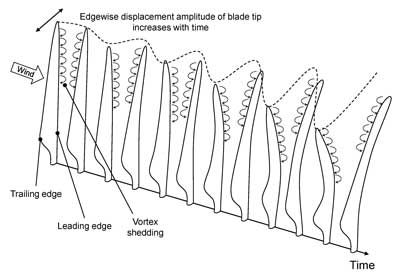 Edgewise vibration (EV) is an aeroelastic resonant phenomenon induced by the wind that can occur when a wind turbine is parked with a brake applied or idling (e.g. not producing power). While EV is an infrequent event, the authors have conducted several blade failure investigations that identified EV as the mechanism of failure. The investigations involved blades designed and manufactured by multiple entities, with blade lengths ranging from approximately 40 metres to more than 80 metres. This range encompasses most utility-scale blade lengths currently in production. EV is a specific case of vortex-induced vibration, where shed vortices in fluid flow around a structure impart forces to the structure, resulting in oscillatory motion. EV is characterised by increasing blade deflections (Figure 1), primarily in the edgewise direction, that (for the context of this article) results in blade damage.
By M. Malkin, Principal Engineer, and D. Griffin, Senior Principal Engineer, DNV GL, USA
This article presents the root causes of EV-related blade failure and discusses options for mitigating the risk of EV in new blade designs and on operational turbines. The goal is to promote continued innovation and actions that lead to reduced risk of EV for wind turbine blades.
- Details
- Category: Articles
Problems Faced in Service Life Estimation of Blade Bearings
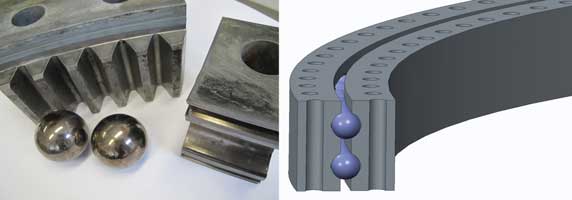 The blade bearings of wind turbines allow the required oscillation to control the loads and power of the wind turbine. The pitch system brings the blade to the desired position by adapting the aerodynamic angle of attack. The pitch bearing, which is connected to the blade and the hub of the turbine, is subjected to high axial forces and bending moments. The conditions of these bearings are unique and most standards to estimate bearing service life are designed for rotating bearings and do not consider the oscillation. This article gives a brief overview of the current problems of blade bearings. The article focuses on the tribological challenges like fatigue life calculation of oscillating bearings, different wear damage modes like false brinelling and fretting wear, grease lubrication and the contact conditions occurring under different operating environments.
By Fabian Schwack and Prof. Dr.-Ing. Gerhard Poll, Institute of Machine Design and Tribology, Germany
Cost of Energy
The expected life of the components of a wind turbine affect the cost of energy, which is an important factor for wind to be competitive against other energy sources. Blade bearings have significant effect on costs. Therefore, life estimation of blade bearings needs to be improved for higher economic efficiency.
- Details
- Category: Articles
Spinner Anemometer Provides Transparency in the Performance of All Turbines in a Wind Farm
Wind turbines are energy producing devices. Hence it is important for the customer and the manufacturer to know if a turbine efficiently converts the kinetic energy from the given wind conditions into power. This power performance characteristic is commonly expressed as electrical power (output) versus horizontal wind speed (input) measured under free inflow conditions at a distance of two to four rotor diameters in front of the turbine. Here is where the big dilemma in the wind industry lies.
On the one hand every turbine should be monitored to make sure its performance characteristic is within the specification, but on the other hand it is almost impossible to measure the wind quantities at all turbines and at all sites, using met masts or other non-standard forward-looking measurement systems.
By Harald Hohlen, ROMO Wind