



- Details
- Category: Articles
First Reference to Help Ensure Decisions are Rational and Unbiased
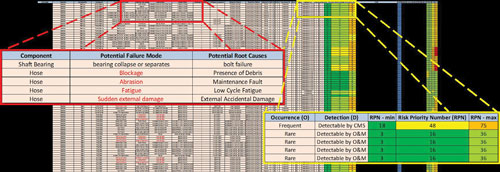 The Top 30 Wind Turbine Faults chart is a database of the most significant failure mechanisms, identified through a failure modes and effects analysis (FMEA), which is validated and regularly updated using information available in the public domain and Lloyd’s Register’s experience of working with wind farm operators. This provides a basis for intelligent decision-making during new product design, sensor selection, configuration of condition monitoring software, SCADA specification, O&M management specification and O&M task prioritisation.
By Mark Spring, Senior Wind Loading Specialist, Lloyd’s Register, UK
A risk-based approach ensures a logical, balanced treatment of failure mechanisms. Quantitative and qualitative inputs are combined, relating both to common and rare failure scenarios. The data is converted into knowledge and stored in a consistent manner, using advanced software which is readily interrogated to present clear health and performance indices to be used for decision-making.
- Details
- Category: Articles
The Multiple Facets of this Subject, Challenges and Latest Advances
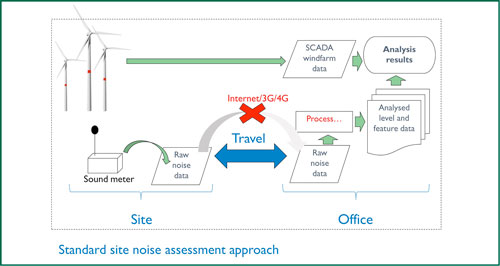 Noise is one of the environmental impacts of a wind farm that requires attention, and can in some cases represent a key constraint on the farm’s operation. Regulation and therefore control of this noise has tended to focus on the level or ‘loudness’ of the noise, which is challenging in itself to measure. But recently increasing attention has been given to features in the noise (in other words its character). Objective measures of these aspects have been developed but they still require careful and time-consuming analysis. Advances in the capabilities of sound measuring equipment are, however, helping practitioners and wind farm operators to obtain results more directly.
By Matthew Cand, Executive Acoustic Engineer, Hoare Lea Acoustics, UK
Although wind turbines are not in themselves very noisy when compared, for example, to large industrial plant or transportation sources, they still produce a certain level of noise which needs to be adequately controlled. This noise is produced by the rotation of the blades as well as mechanical components in the nacelle.
- Details
- Category: Articles
A Pathway to a New Offshore Wind Business Model
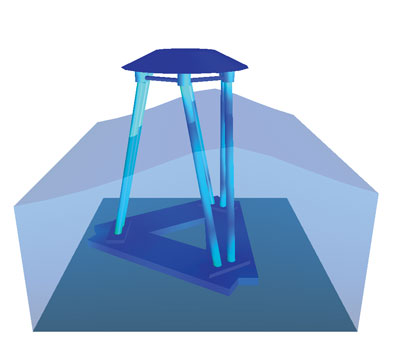 Numerous organisations and agencies are focused on offshore wind cost reduction initiatives throughout the life cycle and across the supply chain but few are focused on the issue of installation. Capacity will have to increase three-fold to meet even the most conservative of 2050 estimates for offshore wind energy needs. While significant cost reduction is a big prize, it and the problem of lack of construction capacity will not be solved without major change, unless there is massive expenditure on installation vessels. However, as projects are risk averse and resistant to change and the industry is capital intensive, the risk of major change is not one that projects are keen to bear. For them, minor change is preferable. This article sets out how a pathway to major change can help the industry mature and reach its potential.
By Matt Bleasdale, Director, OWLC, UK
The offshore wind industry is still in its infancy and suffering from growing pains. Currently about 11GW are installed worldwide and industry forecasts for 2050 range between 150 and 350GW. To achieve even the low estimate, costs need to be reduced and installation rates increased.
- Details
- Category: Articles
 The Blade Way Concept
During the past few years the market for servicing existing wind turbines has grown rapidly. One of the more significant market segments is for exchanging blades. Commonly, large mobile cranes are used, together with a blade yoke. The costs associated with the use of a crane are high, and so cheaper solutions are being sought.
By Per Fenger and Ruben Tjell Lambertsen, Liftra, Denmark
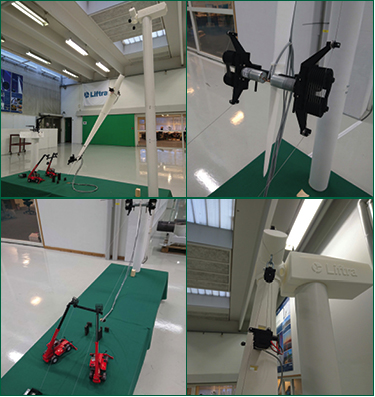
The already high costs of using cranes are often increased significantly by the groundworks necessary to improve the approach roads to the wind farm and allow access across the site itself. Availability is another issue when using large mobile cranes. It can take months to get the needed crane to the desired spot, due to the limited number of these cranes and the distance to the wind farm. One solution to the above challenges is to do away with the need for cranes by attaching pulley blocks to the upper blades and suspending two wires between these and two ground-placed winches. Two yokes are attached onto the wires, one for the blade root end and one for the blade tip end. The blade is clamped and secured by the two yokes which then transport the blade along the wires using the principle of a cableway – which is why the product is named Blade Way.
- Details
- Category: Articles
Advanced Modelling Makes This Possible Without Compromising Safety
 Unlike wind turbine towers and rotors, which are fabricated under controlled conditions, in general foundations must be tailor-made. This is because soil conditions (hard or soft) and available space dictate the solutions for the foundation. However, the perception is that optimisation of foundation designs leads to higher risk. Maybe due to this the average foundation designer takes a simple, conservative and conventional design approach. But a client should look at things in a different way. Saving money is one thing, saving materials and reducing CO2 emissions is another. A client should aim to have an optimised design. The skills and experience are available and have shown that substantial design optimisations are possible, without increasing risks.
By Axel Jacobs, Civil Consultant Wind Energy, ABT, The Netherlands
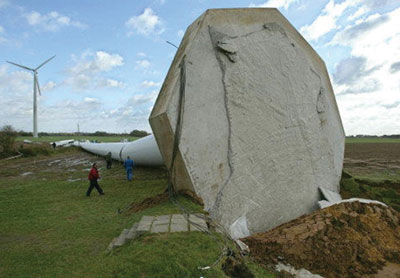
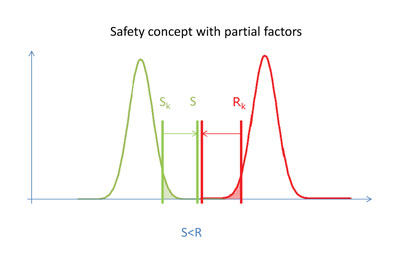 Figure 1 shows an example of a project were something went wrong with regards to the foundation. You can look at it in two ways:
- Details
- Category: Articles
A Monolithic Concrete Platform for Floating Offshore Wind Turbines
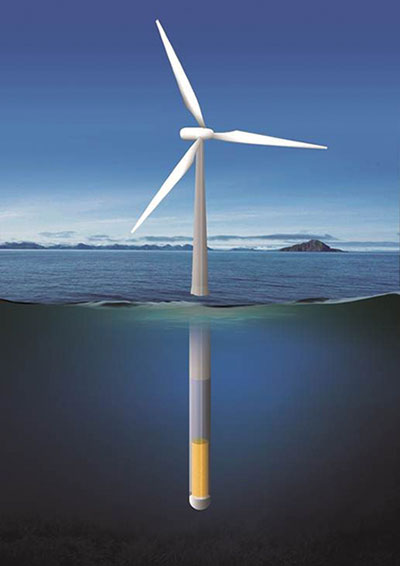 A novel concept of a floating platform for supporting wind turbines (named WindCrete) has been developed at the Universitat Politècnica de Catalunya (UPC) in order to substantially reduce the capital expenditure or CAPEX for floating offshore wind turbines. The concept is based on a monolithic full concrete structure, including the tower and the floater, which also allows a significant reduction of the operating expense, or OPEX. The basics of the concept are presented in this article, including the advantages of concrete in the marine environment, the main dimensions and the hydrostatic and hydrodynamic properties of WindCrete.
By Climent Molins and Alexis Campos, Universitat Politècnica de Catalunya, Spain
WindCrete consists of a monolithic concrete floating spar buoy and includes both the tower and the floater built in a continuous single piece. This offers a significant cost reduction during the construction and the structure is virtually free of maintenance during its service life (50 or more years). The main hydrostatic and hydrodynamic properties have been checked and validated through experiments in a wave flume, and coupled aero-servo-elastic-hydrodynamic analyses were used to check WindCrete’s structural integrity. Accurate material cost estimations for the platform, including all its internal steel reinforcements, were also performed. A cost comparison with a steel equivalent platform design highlights a material cost reduction larger than 60% in the case of the full concrete design. For the preliminary design, the NREL 5MW was used as the reference wind turbine (see Figure 1).
- Details
- Category: Articles
Effective Reduction Using a Low-Speed Coupling Made of Advanced Composites
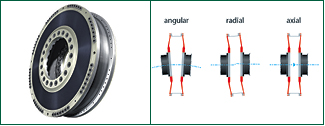 Poor drive-train reliability is still one of the main hurdles to get over in order to achieve a more competitive cost for wind energy. Many surveys confirm that gearbox failure rates are moderate compared to other components but, once a failure occurs, it leads to the highest downtime and a considerable loss of energy production. According to the results of investigations carried out by GL Garrad Hassan regarding the relative cost of energy, the reduction of gearbox failures rates by 50% would save revenue losses by almost 40% compared to the initial capital cost of the gearbox. Joint investigations by the National Renewable Energy Laboratory (NREL) and Alstom, with the target of improved drive-train reliability, have shown that non-torque loads (bending moments) can significantly affect the reliability of the gearbox. Non-torque loads are caused by aerodynamic loads, rotor overhung weight and drive-train weight, and occur independently of the drive-train concept. Low-speed couplings are pictured as a potential remedy for new drive-train layouts to solve the problem ‘outside the gearbox’.
By Alexander Kari, Geislinger GmbH, Austria
 This article explains how a composite low-speed coupling reduces non-torque loads and improves the drive-train’s dynamic behaviour significantly. At the same time, the coupling does not add unnecessary weight, maintenance or complexity to the wind turbine. This is a somewhat new approach for wind drive-trains – but a potential remedy to increase robustness.