



- Details
- Category: Articles
 A Crane-Less Solution for Great Heights
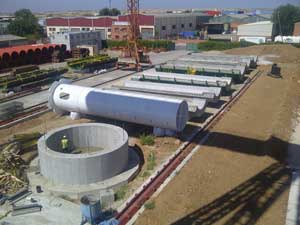
Concrete towers have become an increasingly popular choice in the wind industry around the world because of their superior ability to support larger turbines at higher hub heights. However, this market is being constrained when it comes to increasing tower height because of the limited availability of the powerful cranes needed to erect such tall towers.
By Ramón López Mendizábal, Director, Esteyco, Spain
Some years ago there were just a few units and a single turbine manufacturer using precast concrete towers. Since then, the market has seen a spectacular increase in the demand for precast concrete towers, with more than two thousand already built. This has allowed for a crucial reduction in the cost of energy because of cost efficiencies in increasing the hub height. Many of the more important markets, each of them with their own particular demands, have begun to adopt these structures, and nowadays all the major turbine manufacturers are looking at the possibility of using concrete towers.
- Details
- Category: Articles
Optimising Aerodynamic Efficiency at the Wind Farm Design Stage
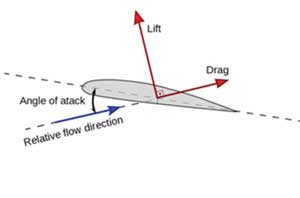 Reduced wind turbine performance, as compared to the manufacturer’s design or warranted power curve, is common outside of the turbine design conditions. On many sites, such as those with steep slopes or considerable forestry, or simply those that experience certain atmospheric conditions, turbines will regularly operate outside the ideal operational conditions without falling outside the operational envelope. This typically results in reduced wind turbine performance and can have a major impact on overall project performance. Prevailing has applied established angle of attack based aerodynamic theories to produce a method of modelling the aerodynamic efficiency of a wind turbine for supplied wind conditions. The presented methodology can be used to provide turbine performance predictions. Accurate turbine performance predictions contribute to better wind farms both by optimising turbine layouts and providing improved preconstruction energy yield estimates.
By Alex Head, Prevailing Analysis, USA and Joel Manning, Prevailing Analysis, UK
Minimising wind farm underperformance requires turbine performance to be quantified at every potential turbine location at the project design stage. This requires both known wind conditions, and a method of calculating turbines’ response to these conditions. Modelling and analysis can be used to site turbines optimally to reduce risk of decreased performance.
- Details
- Category: Articles
Weather Patterns in the USA during 2015
So far, the year 2015 has undoubtedly been one of challenge for many US wind project operators. In terms of performance, the first quarter was one of the lowest on record for large portions of the country with some areas seeing wind speeds up to 50% below average.
By Dr Jim McCaa, Manager of Advanced Applications, Vaisala, USA
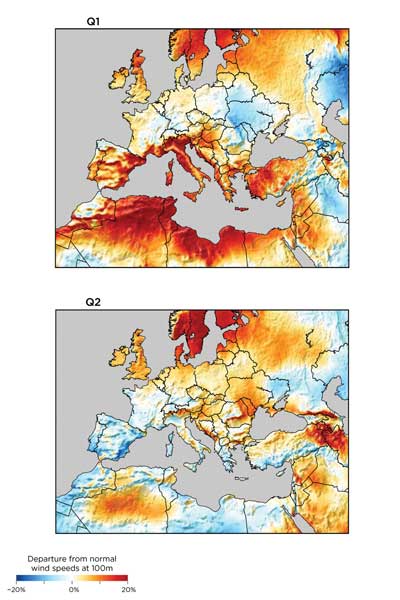 Recent reports of low production both at individual projects and even across entire grid systems such as California and Texas captured a lot of attention and raised a great deal of concern for utilities and project owners, a number of whom reported expected shortfalls in quarterly and annual wind production.
- Details
- Category: Articles
Doing Without Blades
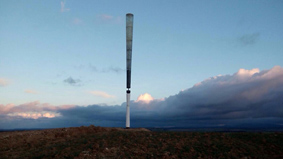 Vortex Bladeless is a technology that uses the vortex effect. Basically, Vortex Bladeless consists of a conical cylinder fixed vertically on an elastic rod. The cylinder oscillates in the wind, which then generates electricity through a linear alternator’s system.
By David J. Yáñez Villarreal, David Suriol Puigvert and Raúl Martín Yunta, Vortex Bladeless, Spain
In Vortex Bladeless the outer inverted conical cylinder is designed to be effectively rigid while still being able to oscillate freely because it is fixed at its base to a flexible supporting rod. The top of the cylinder is unconstrained and has the maximum amplitude of the oscillation. The structure is built using resins reinforced with carbon and/or glass fibre, materials used in conventional wind turbine blades.
- Details
- Category: Articles
 A Revolutionary Idea for Energy Storage
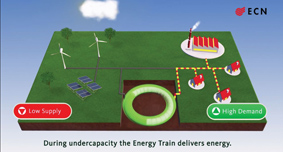
In order to address the problem of global climate change, a number of measures are needed. Apart from saving energy, electricity increasingly needs to be produced using renewable sources. The European Commission’s energy road map for 2050 states that 55% of the total amount of electricity produced in 2050 should come from renewable sources. The Dutch government has an even more ambitious goal (national energy agreement) and wants to have a climate-neutral energy supply by 2050. In order to reach these targets, a lot of renewable energy sources, such as solar and wind, must be installed in the next few years and this will lead to an increasing proportion of intermittent power. This will mean that imbalances between the supply and demand for electricity are likely to become more common.
By Wouter Engels, ECN, The Netherlands
Energy Storage
In an energy system with large amounts of renewable energy like wind power and solar power,energy storage is a key requirement to ensure a constant and safe energy supply in the future. Energy storage itself is not a new idea. Pumped hydro has already been used for years and currently accounts for around 95% of all installed storage facilities. However, this technique comes with some disadvantages. In particular, it requires certain topographical conditions (i.e. mountains) that may not be readily available everywhere where you might want to store energy. The Netherlands, for instance, does not have mountainous regions where this would be feasible. Other techniques that are currently in use include compressed air, thermal storage, batteries and flywheels. Each of these techniques has its advantages and disadvantages.
- Details
- Category: Articles
 Modifying Electrical Architecture to Maximise Wind Farm Production
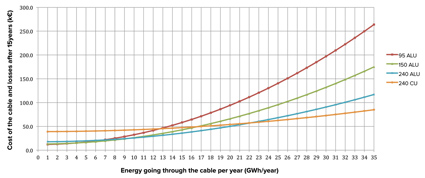
As wind energy seeks to become cost-competitive with traditional forms of generation, developers and operators in the maturing European onshore market continue to look for ways to optimise project performance and bring down long-term costs. While there are many ways to boost the efficiency of operational portfolios, arguably the most effective way to make cost reductions is to return to the drawing board and explore how subtle design modifications based on operational experience can influence the long-term performance of a project before it is constructed.
By Thomas Blondot, Construction Project Manager, and Carla Vico, Operations Director, Greensolver, France
While every project is different, proactively targeting potential inefficiencies through design adjustments in the early phases of project planning can have a significant impact on the performance of a wind farm over its 15–20 year lifetime – and a direct influence on long-term returns.
- Details
- Category: Articles
Using Hydrogen and Ammonia Fuels via Underground Pipelines
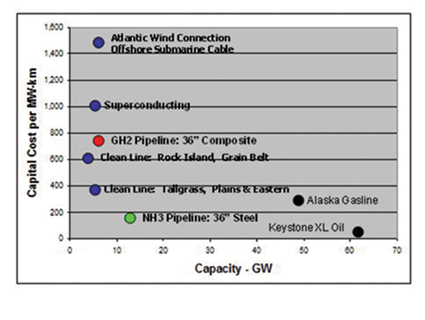 Humanity's greatest challenge at present is converting the world's largest industry from around 85% fossil to 100% renewable energy (RE) sources as quickly as we prudently and profitably can. Nothing less will allow us to escape the likely synergistic consequences of large-scale fossil fuel combustion, including rapid climate change and global warming, accelerating sea-level rise, ocean acidification, species extinctions and violent human conflicts. Although large amounts of RE could be produced, existing electricity grids are not capable of transmitting this energy to where it is needed. The author argues that rather than just extending electricity grids it would be worth looking at alternatives (such as hydrogen and ammonia carried via underground pipelines) for storage and transmission of RE.
By Bill Leighty, The Leighty Foundation, Juneau, Alaska, USA
Jacobson and Delucchi have demonstrated that we can run the world on wind, water and solar (WWS) energy [ref. 1]. The wind energy of the 12 Great Plains states, if fully harvested on about 50% of these states’ aggregate land area, transmitted to distant markets, and guaranteed to be available (‘firmed’) at an annual scale with storage, could supply the entire annual energy demand of the USA (about 10,000 terawatt-hours, TWh). However, the existing Great Plains electric transmission export capacity is insignificant relative to this resource. Any large, new electric transmission systems, or fractions thereof dedicated to wind energy, will: