




- Details
- Category: Articles
Could It Change the Game for Renewables?
 What if reliable and cheap wind energy could be generated, stored and distributed straight out of a box? EnerKíte GmbH from Germany has developed a novel technology to harness the stronger and steadier winds at higher altitudes. At average to fair onshore wind conditions the kite-based wind power plants – or airborne wind energy converters – allow for capacity factors way above 70% while aiming to keep the cost of electricity below 5 euro-cents per kilowatt-hour. The combination of stronger winds at higher altitudes and the low design wind speeds of 7.5m/s enable capacity factors higher than offshore power plants at a lower cost. Distributed generation, storage and hybridisation with other renewables could all help towards 100% renewable scenarios.
By Alexander Bormann, CEO, EnerKite, Germany
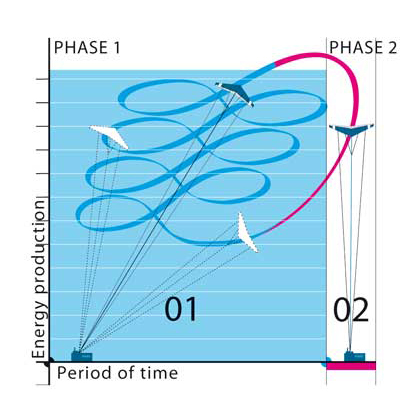
The portable EnerKíte container, bearing the fully automated kite (wing), a launching and landing mast, a generator winch and integrated battery storage, is ready for use quickly. The principle of the EnerKíte is quite simple (see Figure 1). The kite flies a figure-of-eight shape in cross-winds using the currents above the boundary layer to unfurl the tether lines with optimal force and speed (phase 1). The tether lines are let out and power a generator winch on the ground. Unlike conventional wind turbines, only the ultra-light wing is placed at altitudes of 200 to 300 m (Figures 2 and 3). Once the tethers are fully unrolled, the recovery phase (phase 2) begins.
- Details
- Category: Articles
 Getting Ready for the Future
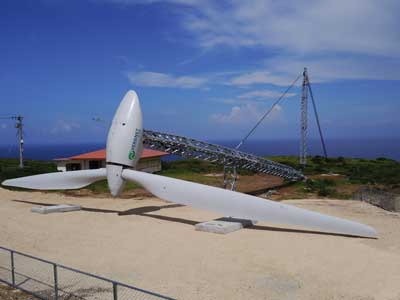
Within a few years there are not likely to be many places in the world with traditional mega or micro electricity grids. As use of renewables such as wind and especially photovoltaics increases, sometimes to more than 100%, and the energy supplies are linked to grids worldwide, there will be a need to add storage and smart control systems to enable switches between renewable energies and other fuels such as diesel. However, most traditionally manufactured small and medium wind turbines cannot cope with smart grids.
By Frits Ogg, Renewable Energy Consultant, The Netherlands
As most commercial developers in wind tend to sell and use wind turbines of a megawatt or more (MW wind turbines) because these turbines give the fastest and/or largest return on investment, there is a lack of development of small and medium sized wind turbines. MW wind turbines only serve the highly populated areas in the world that have a strong grid. Over 90% of the world is rural and has a weak or island grid. For technical reasons and because of grid capacity there is usually a maximum of 300kW for feeding in electricity from wind turbines on these grids.
- Details
- Category: Articles
Anemometry Technology to Measure the Wind in Front of the Rotor
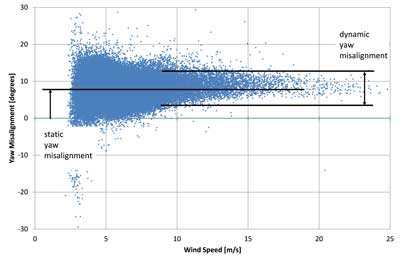 The ROMO Wind iSpin system uses proven ultrasonic technology to measure wind where it first hits the turbine – directly at the spinner. In this way, it is able to measure parameters at the nacelle which until now have been difficult or impossible to measure accurately. Operators gather exact information on the wind conditions in front of the rotor including wind speed, yaw alignment, flow inclination, turbulence, rotor position and temperature. This enables them to check whether their turbines are aligned for the best possible yield. At the same time, the data allows for optimised wind farm management and load reduction, which prolongs the total life of the turbines.
By Harald Hohlen, ROMO Wind Deutschland GmbH, Germany
Unfortunately, most wind turbine measurement equipment in use today is unable to properly measure the wind hitting the turbine. This industry-wide, fundamental wind measurement problem is caused by the fact that the wind turbine’s own wind measurement equipment when located on the nacelle behind the rotor is heavily affected by rotor turbulence and other unpredictable wind conditions. The problem results in inaccurate and imprecise wind speed and wind direction measurements on the wind turbine and, as a consequence, in reduced yaw alignment capabilities. ROMO Wind’s spinner anemometry technology iSpin, which was developed at DTU and improved by ROMO Wind using actual field experience, measures wind quantities like wind speed, yaw misalignment and flow inclination at the spinner in front of the wind turbine rotor, where the wind conditions are more predictable. As a result, iSpin is an ideal tool to measure yaw misalignment and further wind quantities relevant for wind turbine performance measurements.
- Details
- Category: Articles
The Integrated Urban Green Wind Energy Solution
 PowerNEST is a new sustainable energy generation system for the tops of buildings. IBIS Power and Pontis Engineering have joined forces to get PowerNEST to a state where it is ready to enter the European market. The consortium has received a Horizon 2020 SME Phase II grant from the EC and is now fully operational and ready to realise the first demonstration in the Netherlands within a few months. The initial stage of the overall European project consists of installing 25 units within 2 years, therefore gaining sufficient knowledge to develop a standardised mass production design and establish a distribution network. The EU independent review committee awarded a score of 14.35 out of 15.00 to the project with all aspects graded as ‘excellent’.
By Anna Blanch Vergés and Dr Alexander B. Suma, IBIS Power, The Netherlands
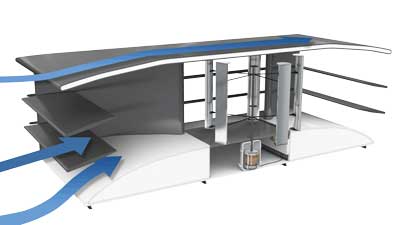 PowerNEST is a roof-mounted system designed to use the wind that collides with a building’s façade, capturing and accelerating it towards a centralised turbine to generate electricity (Figure 1). This system is especially designed to generate energy in the urban environment where most of the energy is used.
- Details
- Category: Articles
A Few Potential Design Alternatives and System-level Reassessment
 In recent years, increasing evidence of failures has been reported from spherical roller main bearings used in three-point mounting (TPM) drivetrains of wind turbines. One of the leading causes has been micropitting, a failure mode that is possibly overlooked by design, selection and life-prediction tools. It remains to be seen if retrofitting problematic spherical roller bearings (SRBs) with improved bearing design solutions can improve their durability. Questions to ask might be: ‘Are the operating conditions of the main bearing well understood?’ and ‘Are the failures caused by deficient design practice or other unidentified external sources within the system?’ These questions fundamentally challenge the underlying design basis and encourage the need for a system analysis approach that is currently being undertaken by researchers from the National Renewable Energy Laboratory (NREL). Specifically, this article discusses a few potential design alternatives and system-level reassessment to circumvent micropitting in main bearings used in TPM drivetrains.
By Latha Sethuraman, Yi Guo and Shuangwen Sheng, National Wind Technology Center, National Renewable Energy Laboratory, USA
Conditions Leading to Micropitting
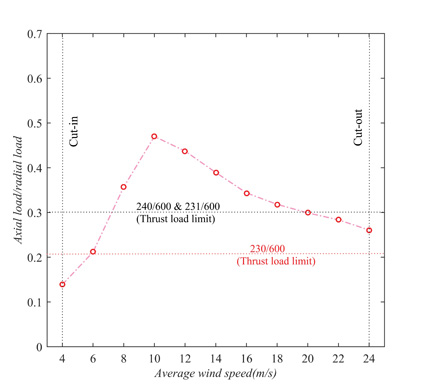
Most common main shaft arrangements for TPM drivetrains in wind turbines rated 1.5–2MW employ SRBs. These bearings exhibit a high tolerance to system deflection and misalignment but limited tolerance to thrust loads (in most bearing designs the axial loads cannot exceed 10‒38% of their two-row radial reaction). Preliminary studies by the authors [ref. 1] were carried out using a system analysis approach for a representative TPM wind turbine with a 230/600 series SRB (having a design axial load limit that is 22% of the radial loads). Modelling results (see Figure 1) showed that this design limit is exceeded for a majority of the turbine’s operating conditions.
- Details
- Category: Articles
Development of a Collision Risk Model
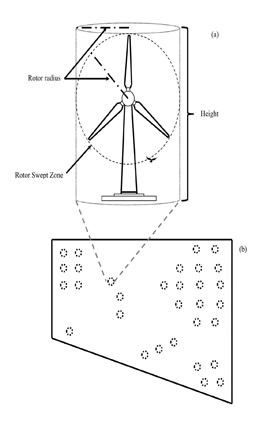 The US Fish and Wildlife Service (FWS), in conjunction with the US Geological Survey and Washington State University, have developed a statistical model that enables a wind facility to predict its expected number of bird fatalities in advance of construction. Avian fatalities at wind facilities are a serious consideration for both wildlife and wind facility managers. Many local, regional and international laws protect various bird species, making an understanding of a facility’s potential impact invaluable for planning and conservation purposes.
By Dr Leslie New, Washington State University, Vancouver, USA
The new model builds on existing approaches, making use of best available biological knowledge and directly incorporating uncertainty so that the risk to the facility and avian species can be fully assessed.
- Details
- Category: Articles
The Effect on the Bottom Line
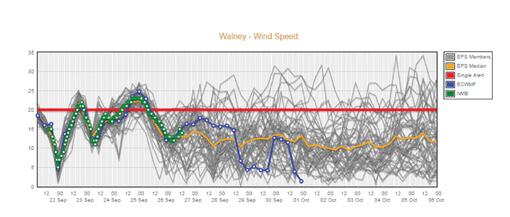 One of the most difficult jobs facing project managers tasked with the mobilisation of critical resources in the renewables industry is planning ahead for what are often referred to as medium range weather impacted events. Forecasting weather over longer periods (typically up to 15 days in advance, often termed medium range forecasts) is extremely difficult to predict with any degree of accuracy due to the volatile and chaotic nature of the atmosphere. Very small variations in the initial conditions of a computer forecast model can lead to huge variations in the forecast – a phenomenon known as the ‘Butterfly Effect’. This is why forecasters can typically only forecast conditions up to roughly three days ahead with any degree of precision. Beyond this timescale, conditions become significantly more influenced by these tiny initial variations.
By Polly Kirk, Regional Marketing Executive, MeteoGroup, UK
Understanding Uncertainty
The key to understanding medium range weather forecasting lies in knowledge of how to deal with uncertainty. Weather is a risk-related activity because forecasters are dealing with uncertainty. One of the best ways of addressing this, whether it be related to weather prediction or any other risk assessment activity, is to use probability as the mechanism of measurement.