



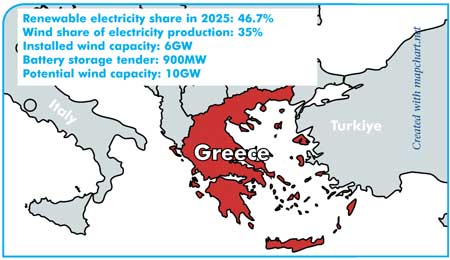
 Greece has some of Europe’s most attractive renewable energy resources, with renewables accounting for 46.7% of electricity production in 2025 and wind playing a leading role. Yet the country faces a fundamental challenge – to turn its renewable potential into additional operating capacity while ensuring adequate grids, storage and predictable permitting.
By Victoria Alexandratou Kerner, CEO, WRE Group, Greece
Having worked in Greece’s renewable energy sector for more than three decades, I have witnessed the country’s transition from early development of wind and solar projects to established renewable energy market. The next phase will require investment in generation, as well as major improvements in infrastructure, permitting and system flexibility.
Greece has exploited wind energy for thousands of years, with traditional windmills used to grind grain and pump water. Modern wind development began with the installation of a turbine on Kythnos in 1982 under a European Union initiative, followed by Law 2244/1994, the legal framework for large-scale electricity production from renewable sources.
The country’s geography offers exceptional opportunities for further wind development. Greece has almost 6,000 islands, 124 of which are inhabited. While larger islands such as Crete are connected to the mainland grid, many smaller islands continue to rely on autonomous systems historically powered largely by fossil fuels. Replacing imported fossil fuels with locally produced renewable electricity, combined with storage, is therefore an environmental, economic and strategic necessity.
Wind, solar and battery storage can provide complementary generation, flexibility and stability, particularly for autonomous island systems. For smaller islands, integrated renewable energy systems is an important component of future energy security.
However, renewable energy development remains a lengthy process. Despite improvements in permitting, autonomous renewable projects can remain under development for more than a decade. Even after the acquisition of necessary licences, opaque administrative procedures and delays can prevent the completion of projects.
This particularly affects small and medium-sized developers, which often lack the financial resources to sustain exceptionally long development cycles. The result is increasing market consolidation, as larger multinational companies acquire smaller developers with projects at advanced licensing stages. A predictable, time-bound administrative process would strengthen competition and allow a broader range of developers to contribute to the energy transition.
Grid capacity is now another major constraint. Congestion and curtailment are limiting further renewable deployment, making additional investment in transmission, distribution infrastructure, and substantially greater storage capacity essential.
Greece continues to rely partly on lignite and imported natural gas, including liquefied natural gas, despite the retirement of older lignite plants, exposing the country to international price volatility and supply risks.
Greece currently has approximately 6GW of installed wind capacity, with the Aegean offering exceptional resources and high-quality sites. Installed wind capacity could approach 10GW in the future, but achieving this depends on overcoming challenges involving public acceptance, permitting, financing and grid availability.
Offshore wind offers another significant opportunity. Projects in northern Greece are progressing through licensing procedures, but offshore development involves higher costs, more complex infrastructure, and greater financing risks. Geopolitical and maritime security considerations must also be incorporated into investment decisions.
Public acceptance remains equally important. Opposition to wind projects has been linked to political debate, landscape and environmental concerns, and claims regarding wildfire risks. These issues must be addressed through transparent environmental assessments, reliable scientific information, and meaningful engagement with local communities. Under Greek law, 3% of wind farm revenues is allocated to local community needs, creating direct economic benefits for host areas.
The next phase of Greece’s energy transition therefore requires coordinated action: faster and more predictable permitting, investment in transmission and distribution networks, substantially greater storage capacity, transparent curtailment rules, and a regulatory framework that supports both smaller domestic developers and larger international investors.
This article is based on the following audio/video WWEA podcast:
Episode 31: Wind Power in Greece: Islands and Renewable Abundance | with Victoria Kerner, WRE
https://wwindea.org/WWEApodcast